
So, what is magic? Well, it’s about creating the impression that the impossible is happening. This is what distinguishes magic from, say, a bar bet, in which someone challenges a punter to do something that looks as if it’s going to be impossible, but then the challenger reveals an easy or cheaty way of doing it, usually involving some slippery redefinition of what the challenge was supposed to be. If, after the performance, the audience can immediately recreate what you’ve done, you have not done magic.
Magic is doing the seemingly impossible and leaving the audience with no idea how you did it – or rather, not knowing how you did it. There are people who always come up with theories of how it’s done and the best magicians build this into their routines, ruling out potential explanations as they go.
There are many forms of magic and most magicians specialise in one area, although some excel at all of them.
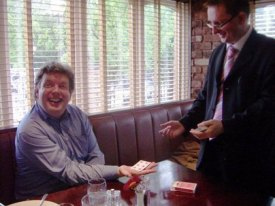 Close-up magic is interactive magic performed for a few people, or even one person, at a time. It is done right in front of the spectator(s) and the magic often takes place in a spectator’s hands. The props used are small things that are easy to carry, such as cards, coins and elastic bands. When close-up magic is done at a table (eg, a dinner table), it is called table magic. When the magician wanders from groups to group of spectators (for example, at a party), this is called strolling magic or mix-and-mingle magic.
Cabaret magic or stand-up magic is performed for a larger audience and, although there may well be spectator participation, it is a show, in a way that close-up is not. The magician is on a stage, or anyway set apart from the audience, and performs larger-scale tricks. The props may be ropes, silk handkerchiefs, bottles, big cards, doves… The type of trick in which the magician repeatedly produces cards, balls, thimbles (or anything) in his or her hands out of thin air is called manipulation.
 Stage magic is done on stage, of course, for a large audience. The difference between stage magic and cabaret magic is that cabaret magic is tricks, typically performed by a magician alone, and stage magic is illusions, performed by a magician with an assistant, with large animals or on a member of the audience. Producing a rabbit out of a hat, therefore, would be cabaret magic, while examples of stage magic would be: making an elephant disappear, cutting a volunteer in half, sticking swords into a box containing a person, the magician locking himself into a trunk and the assistant emerging. Stage magic is distinguished by its large-scale props.
Mentalism is giving the impression of being able to read people’s minds and/or foresee the future. It can be performed in either a close-up or a cabaret setting.
Street magic is traditionally magic performed in the street, which passers-by may stop and watch. These days, it also refers to magic done for or to members of the public approached in the street by a magician and his film crew.
Escapology is ‘magically’ escaping from a straitjacket and out of a locked box underwater or high in the air – the sort of feat that made Houdini famous.
Corporate magic and trade-show magic are magic performed by a magician who has been hired by a company to motivate their employees or raise the public’s interest in their product or service.
Children’s magic is, of course, for children and generally involves comedy and all-round entertainment as well as magic.
Where should a beginner begin?
Close-up magic is the best place to start, for two reasons. Firstly, it’s excellent training and secondly, it’s the cheapest sort of magic to perform because it uses props you have probably already got. Also, it’s important to start performing in front of an audience as soon as you’ve mastered some tricks, and it’s much easier to gather a few people to watch close-up magic than it is to fill even the smallest theatre.
Mentalism is open to the beginner too but you might be surprised how much sleight of hand is involved in mind magic and it’s definitely worth working on your manual dexterity before you perform any sort of magic.
Many people seem to think children’s magic is some sort of soft option but it really isn’t. Children can be unpredictable and uninhibited – do not underestimate how challenging they can be as an audience!